Employers Liability Claims
If you have had an accident at work you could be entitled to claim for pain, suffering and loss of amenity (known as general damages) and your financial losses (known as special damages) arising as a result of the accident. We have detailed below some of the regulations that may be relevant to accidents at work, although these are not exhaustive.
Personal Protective Equipment (PPE)
If you have been injured in an accident at work that could have been avoided if your employer provided you with Personal Protective Equipment eg gloves, eye protection or special clothing then your employer may be liable.
The employees must have the equipment readily available, or at the very least have clear instructions on where they can obtain it.
Manual Handling
Under the Manual Handling Operations Regulations 1992 there is no specific requirements as to weight limits. Instead an ergonomic assessment based on a range of relevant factors is used to determine the risk of injury. If you have been injured as a result of a lifting accident at work, your employers may be liable if they have failed to carry out the appropriate risk assessment. When a more detailed assessment is necessary it should follow the broad structure set out in Schedule 1 to the Regulations.
The Schedule lists a number of questions in five categories:
- the task
- the load
- the working environment
- individual capability (this category is discussed in more detail under regulation 4(3) and its guidance)
- other factors for example use of protective clothing
Each of these categories may influence the others and none of them can be considered on their own.
The control measures under the Regulations are:
- To avoid hazardous manual handling operations so far as is reasonably practicable, for example by redesigning the task to avoid moving the load or by automating or mechanising the process.
- Make a suitable and sufficient assessment of any hazardous manual handling operations that cannot be avoided.
- Reduce the risk of injury from those operations so far as is reasonably practicable. Where possible, you should provide mechanical assistance, for example a sack trolley or hoist. Where this is not reasonably practicable, look at ways of changing the task, the load and working environment.
Call us on 01332 447 998 now to discuss your employers’ liability claim.
Dangerous Substances
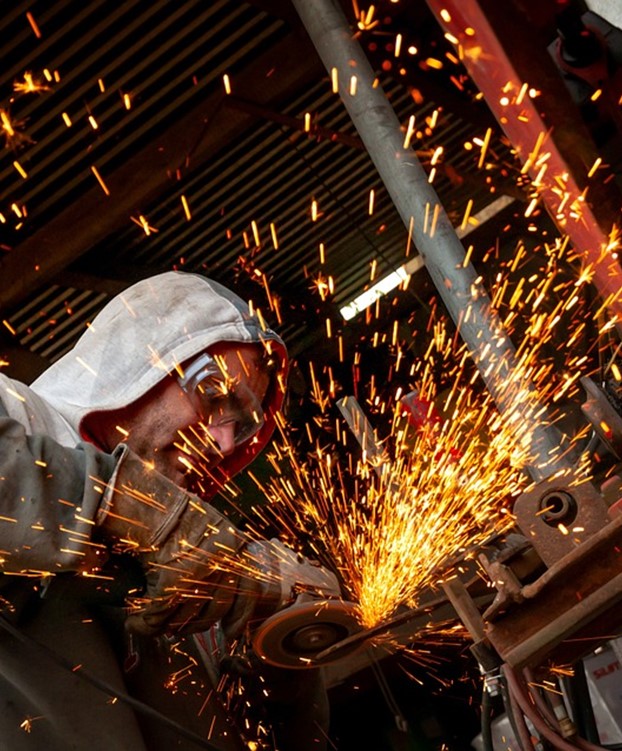
If you have sustained an injury from a dangerous substance at work and your employer has failed to comply with the Dangerous Substances and Explosive Atmospheres Regulations 2002 (DSEAR) which require employers to control the risks to safety from fire and explosions, then your employers may be liable for your accident.
Dangerous substances can put peoples’ safety at risk from fire and explosion. DSEAR puts duties on employers and the self-employed to protect people from risks to their safety from fires, explosions and similar events in the workplace. This includes members of the public who may be put at risk by work activity.
Dangerous substances are any substances used or present at work that could, if not properly controlled, cause harm to people as a result of a fire or explosion. They can be found in nearly all workplaces and include such things as solvents, paints, varnishes, flammable gases, such as liquid petroleum gas (LPG), dusts from machining and sanding operations and dusts from foodstuffs.
Construction Sites
If you have had an accident on a construction site there can often be more than one organisation responsible. Where there are a number of different companies on the site, your employer, other companies and their employees together with the main contractor owe you a duty of care. If one or more parties have failed in their duty and you have sustained an injury, you will be able to proceed with a personal injury claim against the relevant party/parties.
Working at Height
If you have fallen from a height and sustained an injury during the course of your employment, your employer may be liable if they have failed to comply with The Work at Height Regulations 2005. The Regulations apply to all work at height where there is a risk of a fall liable to cause personal injury.
They place duties on employers, the self-employed, and any person that controls the work of others (for example facilities managers or building owners who may contract others to work at height).
Other Employees
Your employer may be vicariously liable for acts or omissions of another employee. If you have sustained an injury as a result of the fault of another employee your employers may have to pay compensation.
Call us on 01332 447 998 now to discuss your employers’ liability claim.